
Department of Electrical and Electronics Engineering
Delivering strong engineering foundations and industry-ready computing professionals for the global technology landscape.
Department of Electrical and Electronics Engineering
Electrical and Electronics Engineering is a key discipline that offers unbridled career opportunities to youngsters these days. From complex defense systems to simple cooking appliances, this field covers it all. The scope for growth in this empowering discipline is indeed tremendous.
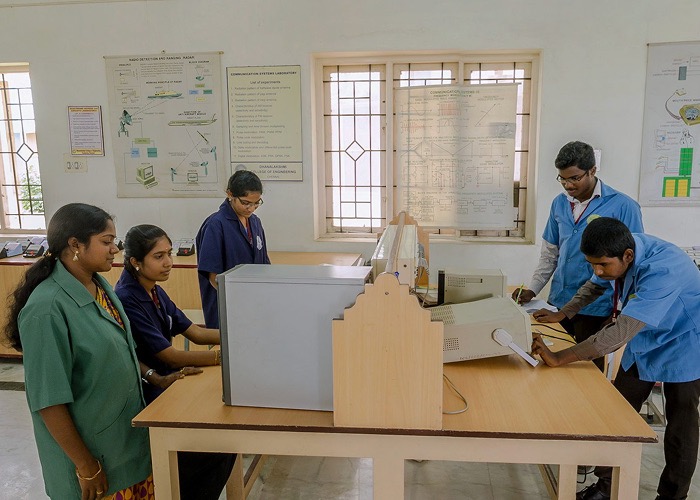
At DCE, we understand that only a hands-on approach will yield top-of-the-line engineers. We are proud to say that our students spend more time in the laboratories than in the classrooms. This kind of a practical approach simply means that they grasp complex concepts at application-based problem solving. Our students are sent to top MNCs for better internships. This makes them industry-ready even as they acquire their engineering degree.
Programmes offered
Electrical and Electronics Engineering is a key discipline that offers unbridled career opportunities to youngsters these days. From complex defense systems to simple cooking appliances, this field covers it all. The scope for growth in this empowering discipline is indeed tremendous.
At DCE, we understand that only a hands-on approach will yield top-of-the-line engineers. We are proud to say that our students spend more time in the laboratories than in the classrooms. This kind of a practical approach simply means that they grasp complex concepts at application-based problem solving. Our students are sent to top MNCs for better internships. This makes them industry-ready even as they acquire their engineering degree.
Vision:
To provide candidates with knowledge and skill in the field of Electrical and Electronics Engineering and thereby produce extremely well trained, employable, socially responsible and innovative Electrical and Electronics Engineers
Mission:
M1:To provide rigorous learning experience for the students to produce creative solutions to society’s needs
M2: To produce electrical engineers of high caliber, conscious of the universal moral values adhering to professional ethical code
M3: To provide highest quality learning environment for the students emphasizing fundamental concepts with strongly supported laboratory and prepare them to meet the global needs of the industry by continuous assessment and training
This programme is designed to equip students with strong fundamentals, problem-solving skills, industry readiness, and lifelong learning capability
Programme Educational Objectives (PEOs)
Fundamentals:
To provide students with a solid foundation in Mathematics, Science and fundamentals of engineering, enabling them to solve complex problems in order to develop real time applications
Core Competence:
To train students to meet the needs of core industry with an attitude to learn new technologies
Breadth:
To provide relevant training and experience to bridge the gap between theory and practice which enables them to find solutions to problems in industry, and research that contributes to the overall development of society
Professionalism:
To inculcate professional and effective communication skills to the students to make them lead a team and stand as a good decision maker to manage any constraints in the environment with good professional ethics at all aspects
Lifelong Learning / Ethics:
To practice ethical and professional responsibilities in the organization and society with commitment and lifelong learning needed for successful professional career
Programme Outcomes (POs)
On completion of the B.E. (EEE) degree, graduates will be able
- To demonstrate knowledge of Mathematics, Science and Electrical Engineering
- To identify, formulate and solve electrical engineering problems
- To design and conduct experiments, analyze and interpret data
- To design a system, component or process as per needs and specifications
- To demonstrate, visualize and work on laboratory and multidisciplinary tasks
- To demonstrate skills to use modern engineering tools, software and equipment to analyze problems
- To demonstrate knowledge of professional and ethical responsibilities
- To communicate effectively by both verbal and written form
- To show the understanding of the impact of engineering solutions on the society and also be aware of contemporary issues
- To develop confidence for self-education and ability for lifelong learning
- To participate and succeed in competitive examinations
Programme Specific Outcomes (PSOs)
- Technical knowledge and analysis:
Apprehend and analyze specific engineering problems in electrical, electronics and allied interdisciplinary areas by applying the knowledge of basic sciences, engineering mathematics and engineering fundamentals - Design and Implementation:
Ability to design and implement the acquired technical knowledge with proficiency in logical programming for applications in Electrical and Electronics Engineering - Development of soft skill and professional ethics:
Ability to communicate effectively with excellent interpersonal skills and demonstrate the practice of professional ethics for societal benefit
The department is equipped with modern laboratories to provide hands-on experience:
- Electrical Machines Laboratory I (DC)
- Electrical Machines Laboratory II (AC)
- Electric Circuits Laboratory
- Control Systems Laboratory
- Power Electronics Laboratory
- Measurement and Instrumentation Laboratory
- Power System Simulation Laboratory
- Electrical Laboratory
- These labs strengthen practical knowledge and technical confidence.
B.E. (Electrical and Electronics Engineering)
| S. No. | Name | Department | Designation |
|---|---|---|---|
| 1 | Dr. Balamurugan S M | EEE | Associate Professor & HoD |
| 2 | Mr. Thirumoorthy P | EEE | Assistant Professor |
| 3 | Mr. Ajai Vaidyanathan H | EEE | Assistant Professor |
| 4 | Ms. Vijayalakshmi R | EEE | Assistant Professor |
The department encourages innovation and research in computing domains.
Students are motivated to participate in:
Research projects
Industry collaborations
Technical workshops
Skill development programs
NIYANTRA 2014 is a national level annual Graphical System Design contest organized by National Instruments. This year a total of 730 teams contested in this event, and 66 teams were shortlisted for next level. Out of 66 teams, Two teams from Dhanalakshmi College of Engineering have been shortlisted. DCE congratulates the two teams led by Mr. Saurav kumar singh and Ms. P. Sumitha. We extend our thanks to NI LabView Academy of DCE for their guidance and support.
Start Your Journey in
Computer Science at DCE
Take the first step towards a successful engineering career with strong academic foundations, industry exposure, and structured placement support.