
Department of Electronics and Communication Engineering (ECE)
Delivering strong engineering foundations and industry-ready computing professionals for the global technology landscape.
Department of Electronics and Communication Engineering (ECE)
Electronics and Communication Engineering (ECE) is a constantly evolving discipline for Mobile phones, Computer chips, Fiber optics to ground-cockpit communications in aeroplanes and so on. This discipline covers the entire gamut of the avenues open for ECE engineers.
At DCE, our experienced professors contribute their best with a single minded focus on learning facilitation to create competent engineers, who are able to strive, survive and succeed in the IT and electronics industries. Adequate emphasis is given to practical application of theoretical concepts so that students are geared to face the challenges of the future.
Programmes offered
Electronics and Communication Engineering (ECE) is a constantly evolving discipline for Mobile phones, Computer chips, Fiber optics to ground-cockpit communications in aeroplanes and so on. This discipline covers the entire gamut of the avenues open for ECE engineers.
At DCE, our experienced professors contribute their best with a single minded focus on learning facilitation to create competent engineers, who are able to strive, survive and succeed in the IT and electronics industries. Adequate emphasis is given to practical application of theoretical concepts so that students are geared to face the challenges of the future.
Vision:
To impart professional education integrated with human values to the younger generation, so as to shape them as globally competent technocrats, capable of providing comprehensive solutions to the challenges in deploying technology for the service of humanity
Mission:
M1: To develop highly competent and globally employable engineers in the field of Electronics and Communication Engineering by imparting quality education to meet industrial and societal needs
M2: To inspire students to become responsible citizens with critical thinking, ethical practices, and capable of working in a collaborative environment
M3: To provide a learning ambience that imparts excellence in innovation, research, and leadership
M4: To facilitate the students to work with recent tools and technologies
M5: To motivate and guide students to take up higher studies and establish entrepreneurial ventures
This programme is designed to equip students with strong fundamentals, problem-solving skills, industry readiness, and lifelong learning capability
Programme Educational Objectives
Fundamentals:
To provide students with a solid foundation in Mathematics, Science and fundamentals of engineering, enabling them to apply, to find solutions for engineering problems and use this knowledge to acquire higher education
Core Competence:
To train the students in Electronics and Communication technologies so that they apply their knowledge and training to compare, and to analyze various engineering industrial problems to find solutions
Breadth:
To provide relevant training and experience to bridge the gap between theory and practice which enables them to find solutions for the real time problems in industry, and to design products
Professionalism:
To inculcate professional and effective communication skills, leadership qualities and team spirit in the students to make them multi-faceted personalities and develop their ability to relate engineering issues to broader social context
Lifelong Learning / Ethics:
To demonstrate and practise ethical and professional responsibilities in the industry and society in the large, through commitment and lifelong learning needed for successful professional career
Programme Outcomes (POs)
On completion of B.E. (ECE) degree, the graduates will be able
- To demonstrate and apply knowledge in Mathematics, Science and Engineering fundamentals in Electronics and Communication Engineering field
- To design a component, a system or a process to meet the specific needs within the realistic constraints such as economics, environment, ethics, health, safety and manufacturability
- To demonstrate the competency in using software tools for computation, simulation and testing of electronics and communication engineering circuits
- To identify, formulate and solve electronic and communication engineering problems
- To demonstrate the ability to visualize and work on laboratory and multidisciplinary tasks
- To function as a member or a leader in multidisciplinary activities
- To communicate in verbal and written form with fellow engineers with society at large
- To understand the impact of Electronics and Communication Engineering in the society and demonstrate awareness of contemporary issues and commitment to give solutions exhibiting social responsibility
- To demonstrate professional and ethical responsibilities
- To exhibit confidence in self-learning and ability for lifelong learning
- To participate and succeed in competitive exams
Programme Specific Outcomes (PSOs)
- To analyze, design and develop solutions by applying foundational concepts of electronics and communication engineering
- To apply design principles and best practices for developing quality products for scientific and business applications
- To adapt to emerging information and communication technologies (ICT) to innovate ideas and solutions to existing/novel problems
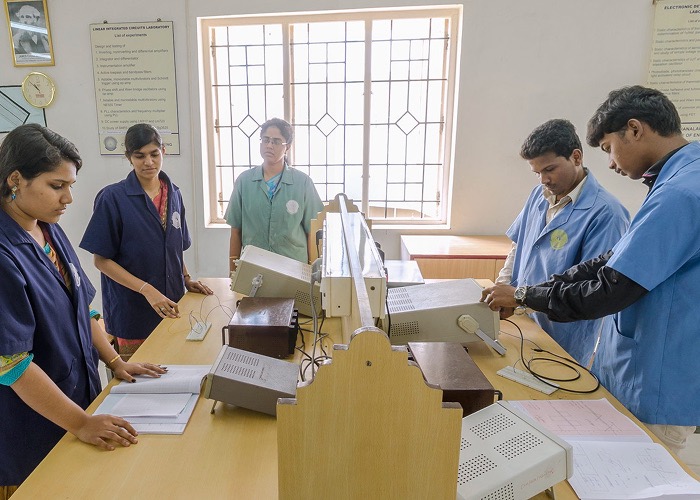
The department is equipped with modern laboratories to provide hands-on experience:
- Electronic Devices Laboratory
- Electronic Circuits and Simulation Laboratory
- Digital Electronics Laboratory
- Microprocessor and Microcontroller Laboratory
- Digital Signal Processing Laboratory
- Network Laboratory
- Communication System Laboratory
- Linear Integrated Circuits Laboratory
- Microprocessor and Applications Laboratory
- Electronics System Design Laboratory
- VLSI Laboratory
- Microwave and Optical Laboratory
These labs strengthen practical knowledge and technical confidence.
B.E. (Electronics and Communication Engineering)
| S. No. | Name | Department | Designation |
|---|---|---|---|
| 1 | Dr. Devasena A | ECE | Professor & HoD |
| 2 | Dr. Narasimha Prasad S | ECE | Assistant Professor |
| 3 | Ms. Esther Gandhimathi S | ECE | Associate Professor |
| 4 | Mr. Kumar A | ECE | Assistant Professor |
| 5 | Ms. Pushpa Priya C | ECE | Assistant Professor |
| 6 | Ms. Kiruthika L | ECE | Assistant Professor |
| 7 | Ms. Monisha A M | ECE | Assistant Professor |
| 8 | Ms. Mahalakshmi A | ECE | Assistant Professor |
| 9 | Ms. Pavithra M | ECE | Assistant Professor |
| 10 | Ms. Bhuvanika G | ECE | Assistant Professor |
M.E. (Embedded Systems and Technology)
| S. No. | Name | Department | Designation |
|---|---|---|---|
| 1 | Dr Sivakumar M | ECE | R&D Director |
| 2 | Mr Vijaykumar T | ECE | Assistant Professor |
The department encourages innovation and research in computing domains.
Students are motivated to participate in:
Research projects
Industry collaborations
Technical workshops
Skill development programs
Start Your Journey in
ECE at DCE
Take the first step towards a successful engineering career with strong academic foundations, industry exposure, and structured placement support.